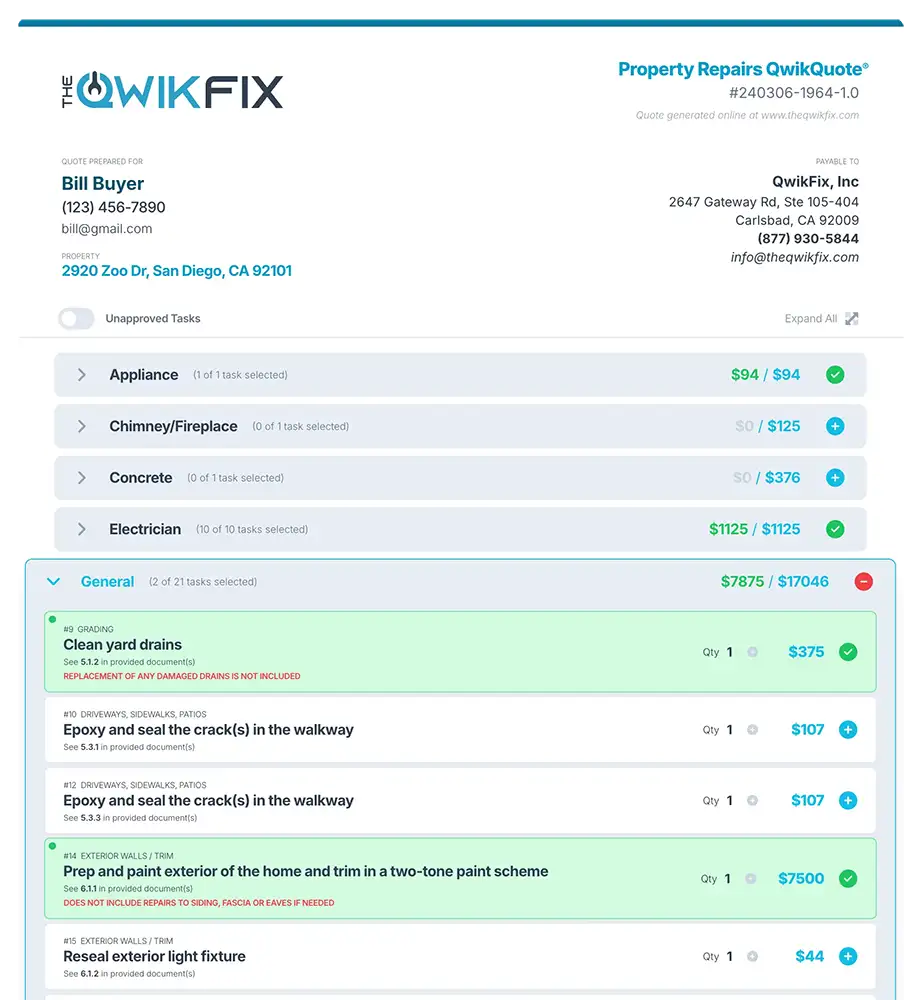
A repair estimate is a ballpark number. It tells you roughly what a fix might cost, but nobody has agreed to do the work at that price. A repair quote is a price for a defined scope from someone who will do the job. After an inspection, ask for quotes when you need numbers you can negotiate with.
Estimate vs quote at a glance
| Repair estimate | Repair quote | |
|---|---|---|
| What it is | An approximate cost, often a range | A price for a specific, written scope of work |
| Who stands behind it | Usually no one. It is information. | The company or contractor who will do the work |
| What it is based on | Averages, cost databases, or AI reading the report | The exact finding, the repair method, and local pricing |
| If the real cost is higher | You absorb the difference | Depends on the terms. Ask before you rely on it. |
| Best used for | Deciding whether to keep looking at a house | Negotiating repairs or credits, and getting work done |
Why the difference matters after an inspection
Your inspection window is usually short. In that time you need to decide what to ask the seller for, and a credit request is only as strong as the number behind it.
An estimate that nobody stands behind tends to start another round of shopping.
The estimate tools say this themselves. Thumbtack’s free Home Repair Estimate states that its prices are estimates and actual prices will vary. A sample Repair Pricer report notes that actual repair cost may be substantially higher than its figures. Those disclaimers are honest. They also tell you what an estimate is for.
AI tools have the same limit. When we put a ChatGPT repair estimate next to a QwikFix quote on the same report, it missed some findings and overscoped others.
A real example
Katie Smithson was selling her home in the Atlanta area when she got her buyer’s repair request after the inspection. The report listed about a dozen findings, and the buyer’s agent asked for $5,000 to cover them. That figure wasn’t based on a bid or a price list. It was a round number.

★★★★★“When selling my home, the buyers requested $5,000 for repairs on items identified in the inspection report. Because I had access to QwikFix, I simply uploaded the inspection report and received an estimate of $1,100 for all repairs listed. I countered the buyers and saved nearly $4,000.”
Katie Smithson, Google review
Her agent suggested offering the buyer a credit (money off at closing in place of doing the repairs), and she countered at $1,100.
She called it an estimate. It was a quote: a price for each finding, matched to the repair the inspector described, from a company ready to do the work at that price. She chose a credit over booking the repairs, which is common. The quote still did its job. A round $5,000 request has nothing behind it. A line-by-line price does.
It works the other way, too. A buyer holding the same quote knows exactly what $1,100 covers, and that someone will do the work for it.
Questions to ask before you rely on any repair number
- Is there a price for each finding? A single total hides which items drive the cost. You want a line for every item in the report.
- Does each line match what the inspector recommended? If the report says “repair” and the price is for “replace,” the number is inflated. The reverse leaves you short.
- Who will do the work at this price? If the answer is “nobody yet,” you have an estimate.
- What happens if the contractor finds more? Ask how scope changes are handled and approved before any extra cost is added.
- Is the contractor licensed and insured for this work? Requirements vary by state. Check with your state’s contractor licensing board, such as the CSLB in California.
- How long is the price good for? Your negotiation and your closing date may be weeks apart.
- When do you pay? Paying in full before the work is done puts all the risk on you.
How QwikFix quotes work
Every line ties back to a finding in the report. Our pricing is based on repairs completed on our platform, not national averages.
We treat each price as firm for the repair as described. The exceptions are a scope change you approve and any item we mark as estimated, usually because it needs a closer look first. Vetted contractors in our network do the work. The balance is due after we provide proof of completion from the contractor and you agree the work is done. Quotes are valid for 60 days.
Have an inspection report?
Get a price for every finding, usually in 24 hours or less.
Request a quote- Housecall Pro, The State of Home Service Spending, May 13, 2026
- Thumbtack, Home Repair Costs for Realtors
- Repair Pricer, sample report (2020)